
Rancho Cucamonga Resident Lookup Coverage
A resident lookup should begin by matching the record type to the fact it can actually confirm. A parcel roll can show an assessed owner and situs. A recorder index can show parties to a document. A court docket can show a case relationship. A vital copy can confirm an event under eligibility rules. A license or business filing shows a public affiliation. The table keeps those answers separate.
| Record | What It Can Confirm | Where | Access |
|---|---|---|---|
| Assessor parcel or roll | APN, assessed owner, situs, mailing distinction, values | San Bernardino County ARC | Map, files, and search modes |
| Recorded instrument | Party, role, instrument type, date, document number | County Recorder | Free index; image at office or by order |
| Court case | Party name, case number, filing date, type, docket | San Bernardino Superior Court | Account, courthouse, or copy request |
| Vital record | Birth, death, marriage, or dissolution event | County or CDPH-VR | Informational or authorized rules |
| License or business file | Professional or entity affiliation and status | California DCA or SOS | Free basic search |
| Historical collection | Past address, household, school, civic, or obituary clue | Library, archive, or newspaper collection | Catalog, database, or reference help |
The best resident lookup uses two independent sources with different custodians. A single exact name is a lead. A name plus an address and a date is a testable identity anchor.
Note: A resident lookup becomes stronger when two custodians confirm different facts about the same dated identity anchor.
Two Rancho Cucamonga Lookup Anchors
Start with two facts before searching. Strong pairs include full name plus prior address, name plus APN, name plus approximate age, or name plus spouse, school, business, or dated event. Use hyphenated and unhyphenated forms, initials, former surnames, compound names, and likely transcription variations. Preserve diacritics when present, while recognizing that older indexes may flatten them.
Rancho Cucamonga’s population makes same-name merges easy. Census QuickFacts reports 174,453 residents in the 2020 Census and a July 1, 2024 estimate of 176,675. Those figures are context, not a person index. Keep a research note with source date, exact role, address type, and the reason two records are being linked.
A business filing can anchor a professional relationship. A deed can anchor a party to a transfer. A court filing can anchor a party to a case date. None automatically proves a current home address. The name-to-record method matters more than a single search box.
Rancho Cucamonga Court Lookup by Name
The Superior Court of California, County of San Bernardino, serves Rancho Cucamonga. The local Rancho Cucamonga District is at 8303 Haven Avenue, while case routing can place family, probate, criminal, juvenile, or other matters at another district courthouse. The county Court Access Portal is the electronic entry point. A paper case number may omit the jurisdiction letters; the Rancho prefix is commonly RS.
The official Court Access Portal gateway requires an account for a person-name search. The court’s official name-search guidance says to enter first and last name and filing-date bounds, with middle name optional. Legal spelling and variants should be searched separately. Quick Search by case number is useful when the number is already known.
The county courthouse is an access channel too. Rancho Cucamonga District hours are Monday through Friday, 8 a.m. to 4 p.m., with public telephone hours from 8 a.m. to 3 p.m. The criminal division number is (909) 350-9764. Public terminals can expose material that remote display rules hide. The court’s file-viewing and copy instructions explain the request route for the courthouse where a case was filed or heard.
The image below comes from the California court-lookup explanation and shows the distinction between a local case lookup and a general web result.
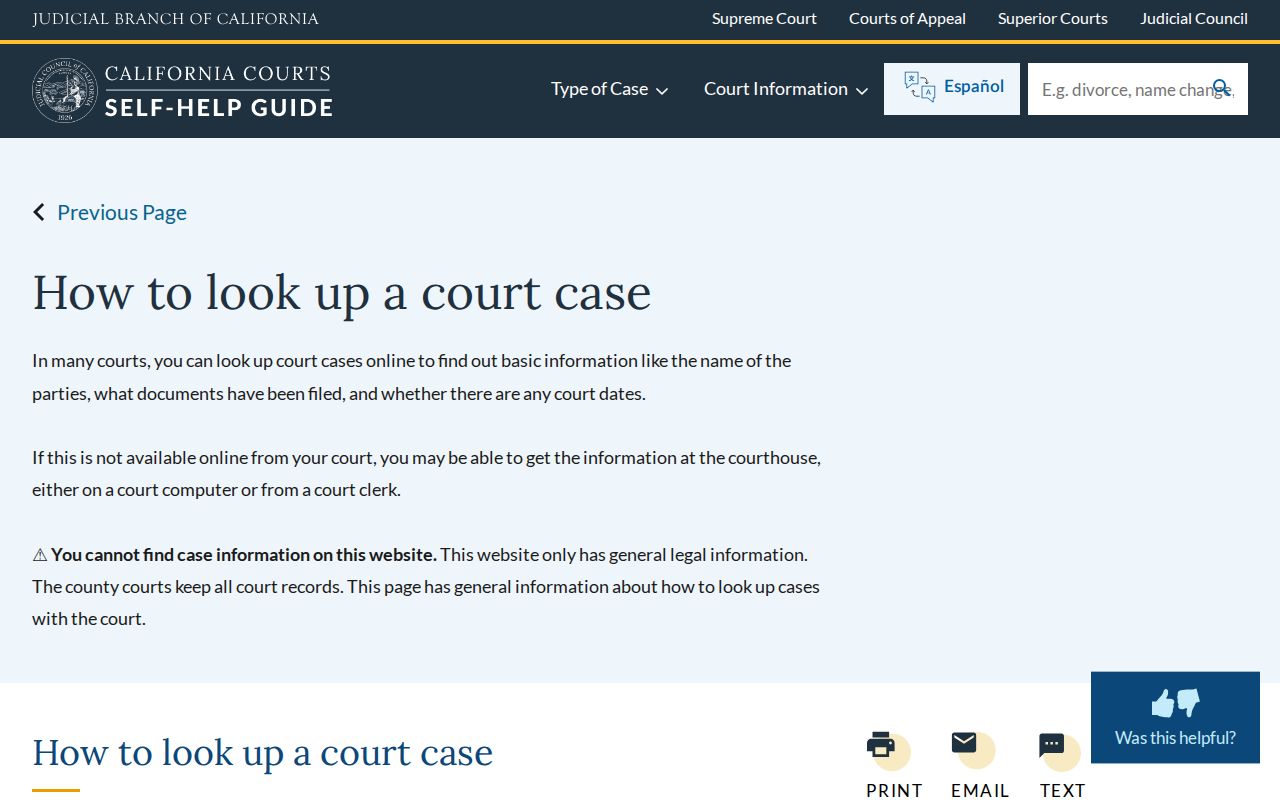
Case information is free. Remotely accessible civil documents may cost 50 cents per page, with older instructions setting a document cap. A result is a court record clue, not a present residence confirmation.
Note: Courthouse access can exceed remote display, so a web non-result should not be treated as a final answer.
Narrow a Rancho Cucamonga Court Lookup
The Court Access Portal name search returns up to 200 records, so a common name needs narrower dates and case type. California rules limit remote access even when a file can be viewed at a courthouse. The portal excludes or limits paternity, minor-related, sealed, confidential, adoption, and some unlawful-detainer material. A web non-result does not prove that no case exists.
| Portal field | Format or rule | Why it helps |
|---|---|---|
| First name | Required for person-name search | Separate common surnames from initials. |
| Middle name | Optional | Use when known; omit for a broader pass. |
| Last name | Required | Repeat with spelling variants and former surname. |
| Filing date from and to | MM/DD/YYYY; From precedes To | Reduces the 200-result ceiling. |
| Case type | Advanced-search dropdown | Focuses civil, criminal, probate, or another available type. |
| Case number | Alternative quick search | Retrieves a known case without a name merge. |
A typical accessible result may show case number, caption or party names, filing date, case type, courthouse, register of actions, and links to public remote documents. A docket is a history of filings and events. It is not the same as the full case file or a final finding.
Verifying a Rancho Cucamonga Resident Record
Use a repeatable verification path when the goal is one person. Start with the name and the second anchor. Use the assessor to test a parcel or assessed owner. Follow a related name into the recorder’s index. Use a court record, license, business filing, obituary, or library source only where its date and role fit. Write down what each source confirms and what it leaves open.
- Record the name exactly, including middle names, former surnames, compound forms, and spelling variants.
- Anchor the name to an address, APN, date, spouse, school, business, or known event.
- Check the appropriate official index and save the source date, role, and result fields.
- Confirm the lead with a second custodian, such as court plus parcel or deed plus obituary.
- Stop when the sources diverge; do not merge people because the city and surname match.
- Docket
- The court’s chronological register of filings and events.
- Index versus image
- A catalog entry describes a record; an image or file supplies the underlying document.
- Certified copy
- A copy issued with the custodian’s formal certification, often subject to eligibility and a fee.
- Party role
- The person’s relationship to a document or case, such as grantor, grantee, plaintiff, or defendant.
This process makes a resident lookup more reliable without implying that public records contain every household member.
Note: Stop a search when the evidence diverges instead of forcing two people into one profile.
Rancho Cucamonga Property Records and Occupancy
The assessor can show an assessed owner, APN, situs, owner mailing address, values, characteristics, transfer information, and exemption indicators. A mailing address can be a PO box or another property. An exemption may support an owner-occupancy clue, but it is not a complete household list. The recorder index adds recorded parties and instruments; it does not convert an address into a live resident roster.
Use Parcel Access to locate the property, then use the recorder’s official index for grantor and grantee research. County images may require Hall of Records or High Desert Government Center viewing, or a paid order. The address workflow belongs to the Rancho Cucamonga street directory; the identity workflow belongs here.
When the known person is an heir, pair a deed chain with probate filings and an obituary. When the clue is an old address, pair the APN with a city directory, census schedule, or newspaper. The custody of each record matters.
Rancho Cucamonga Vital Records and Copies
California vital records distinguish informational copies from authorized certified copies. There is no general rule that all births become open after 100 years or deaths after 50 years. Authorized copies require an eligible requester and a sworn statement, with notarization for mailed requests. Informational copies are marked as not valid documents for establishing identity.
County and state routes differ. CDPH-VR maintains California birth and death files from July 1905 and state marriage or dissolution materials. San Bernardino County can issue copies for events within its custody. The 2026 CDPH fee page lists $31 for birth, $26 for death, $19 for marriage, and $18 for dissolution. County schedules can differ. Identify the event county and custodian before quoting a fee.
The CDPH birth-copy application asks for the registrant, event details, parents, applicant relationship and purpose, copy type, signature, and sworn statement where required. Mail requests need the required notarization and payment. Adoption and confidential-marriage records have separate restrictions.
A vital record confirms an event under its access rules. It does not by itself establish a current Rancho Cucamonga address.
Note: An informational copy can confirm an event while remaining unsuitable for formal identity proof in an official transaction.
Rancho Cucamonga Business Records and Licenses
Public affiliation records can help separate people with the same name. California Department of Consumer Affairs search fields can include board, license type, number, business or person name, city, and ZIP, with result fields varying by board. Secretary of State bizfile can search an entity name or number and return status, formation, jurisdiction, agent, and filed-document information.
The DCA license search and bizfile Online results should be treated as dated affiliations. An agent address, business location, or professional address may not be a home. Compare filing date, status, city permit, and county fictitious-business record before using it as an identity anchor.
Other narrow searches include the San Bernardino Sheriff inmate locator, the California Department of Corrections and Rehabilitation locator, Megan’s Law, and the State Controller unclaimed-property search. A custody facility address is not residence proof, and unclaimed property is a clue that still requires an identity claim.
The image below comes from the state incarcerated-person locator, an example of a record system whose result has a narrow meaning.
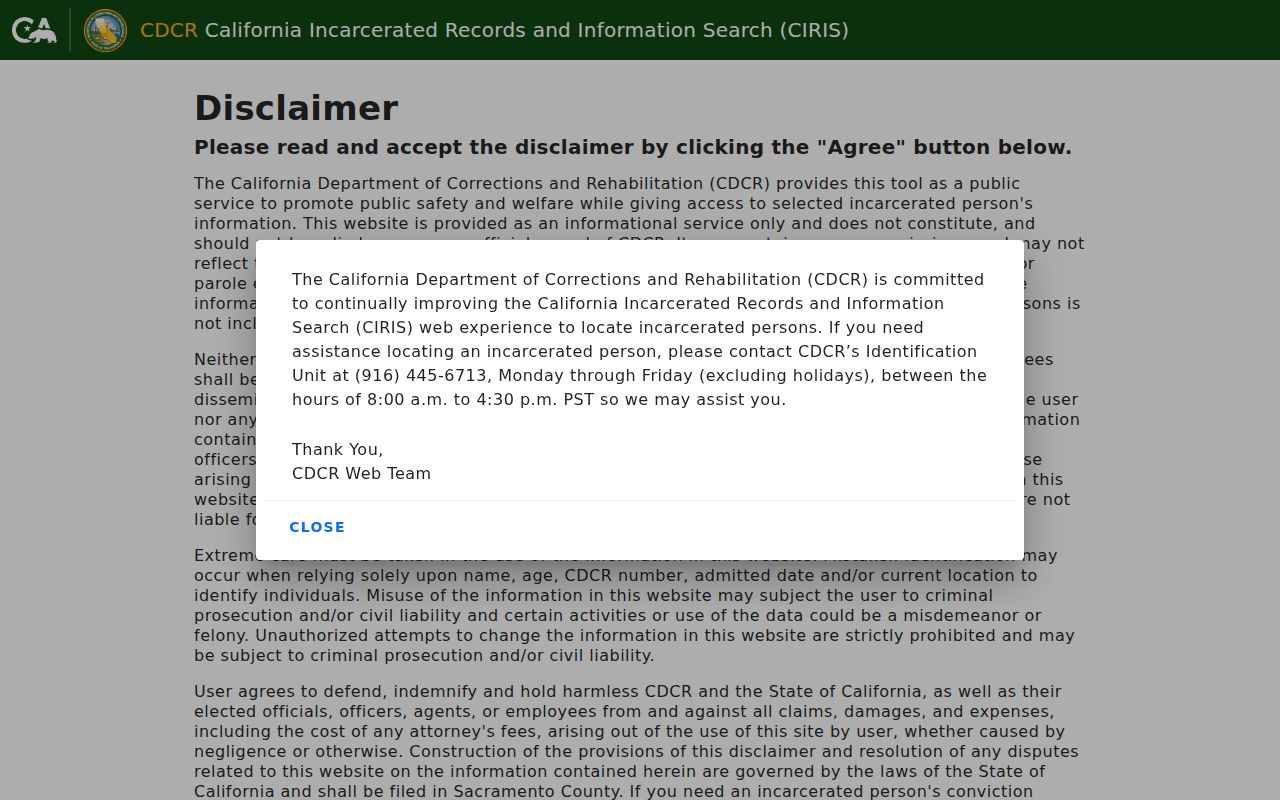
Use the result only for the purpose and status the official source describes.
Rancho Cucamonga Custody Records in Context
West Valley Detention Center is at 9500 Etiwanda Avenue in Rancho Cucamonga and has its own inmate locator. That physical location can make a web search associate a person with Rancho Cucamonga even when the person is in county custody. A booking, facility, or release field is not a residence, guilt finding, or complete case disposition.
The San Bernardino Sheriff inmate locator is free for the released fields. Sheriff reports and incident records use a separate public-records channel. Court follow-up belongs at the Superior Court, and restricted reports may be withheld or redacted. The image below illustrates the custody lookup source.
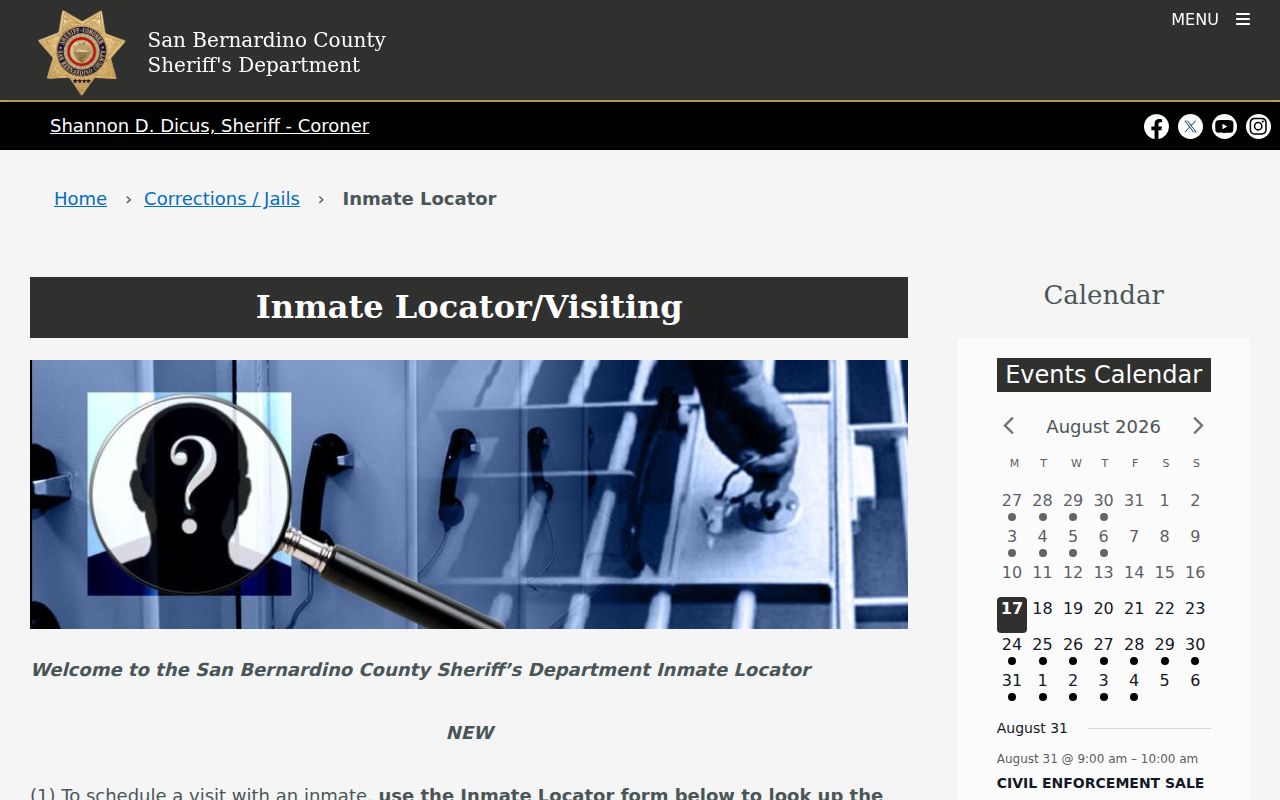
Keep custody geography, court venue, mailing ZIP, assessed ownership, and actual residence as separate fields in every resident lookup note.
Rancho Cucamonga Resident Lookup Limits
California limits several identity trails. My Voter Status is personal verification, not a public name-and-address directory. Elections Code §2194 controls approved voter-file purposes, while Government Code §7924.000 protects sensitive voter fields. Safe at Home creates confidential registration and a substitute mailing address for qualifying participants. DMV personal data, utility accounts, private association rosters, and protected household details are not open lookup sources.
California’s CPRA, Government Code §§7920.000–7931.000, allows requests for existing records that are reasonably described. It does not make an agency conduct research, create a new resident list, or reveal exempt information. Use the custodian’s request channel when a public record is not online, and expect redaction or a refusal where a statute protects the material.
Lawful personal use. Use a Rancho Cucamonga resident lookup for family history, reconnection, civic records, or another lawful personal purpose. Do not use it to stalk, harass, intimidate, or harm any person.
A protected or missing result is part of the record system, not an invitation to work around it. Verify a consequential fact with the office that holds the record and stop when the evidence no longer supports the identity.